
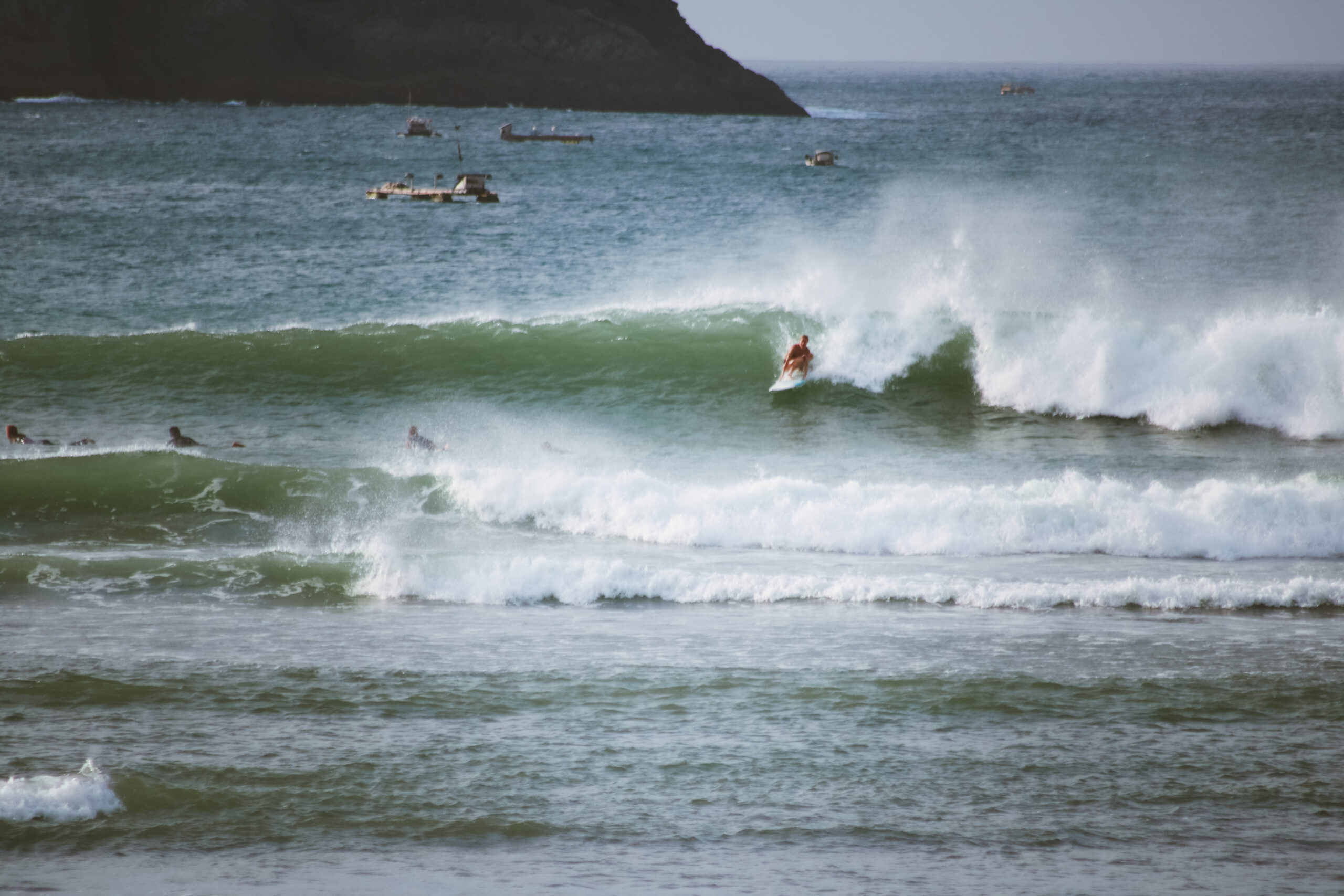
Why capable women freeze in the lineup – and how to regain access to your skills when the ocean feels chaotic.
The surf session is about to start, you’re all nerves, and in the water, you can’t stop worrying. You feel that you don’t know enough and that makes you feel super self-conscious. This fuels your fear of making mistakes and being seen as a beginner by other surfers. It’s a downward spiral from there, and after the surf session you feel exhausted. That feels very frustrating because actually, you love the ocean and you love surfing.
In a recent surf mental training session, a client felt just like that. It’s a pattern I’ve seen in many capable, intelligent, highly responsible women who struggle in the ocean.
They don’t lack motivation. They don’t lack courage. And they have more skill than they sometimes believe.
What they lose, the moment things get busy or unclear, is access.
Access to their own abilities, access to their body, and access to their thinking.
And the moment access is lost, the mental story begins: I can’t think anymore. I don’t know what to do. I’m not safe.
Because of its unpredictability, the ocean makes this visible in a way few other environments do.
Why uncertainty hits harder than waves
My client functions exceptionally well in life. She can make decisions under pressure and handle emergencies. She carries responsibility and manages complexity.
In the water, the same person freezes and panics.
Why? Because she misses predictability and familiarity.
When she knows what will happen next, or if she feels very competent in what she’s doing, her nervous system stays open and calm. When she doesn’t, it goes into survival mode, blocking her completely and flooding her with a feeling of fear.
But the ocean environment doesn’t provide the clarity she craves. The environment is dynamic, there is no script to follow, people move unpredictably, and mistakes are visible.
For a nervous system that learned to equate clarity with safety, this is experienced as threat. Not intellectually – I mean, she knows that she could do it – but physically. The experience of feeling fear in her body is 100% real.
Important to understand is that skills are accessed in „performance mode“, but often blocked in „protection mode“. In other words: trying involves risk, exposure, visible action, and uncertainty. In protection mode, the brain pushes to avoid all these.
This is why so many surfers say they feel like beginners again and again, even after years, because they can’t get out of that protection mode.
The loop that sustains itself: the fear cycle
Once protection mode is active, the sequence is almost always the same:
- You meet your trigger: something that scares or worries you, like a wave, the crowd, or the memory of a past experience.
- You start worrying and overthinking, your mind narrows in on anything that could go wrong. These thoughts make the fear stronger.
- You start feeling intense and uncomfortable emotions like anxiety, fear, dread, nervousness. You feel these emotions as physical sensations such as a racing heart, sweating, nausea, tension, panicky breathing, etc. Everything in you screams AVOID!
- You avoid the situation that you fear. This makes you feel safe for the moment.
And that feeling of relief becomes the proof for your brain that the fear was justified and that something was wrong to begin with.
If you pause for a moment – where in your own sessions does this loop usually begin?
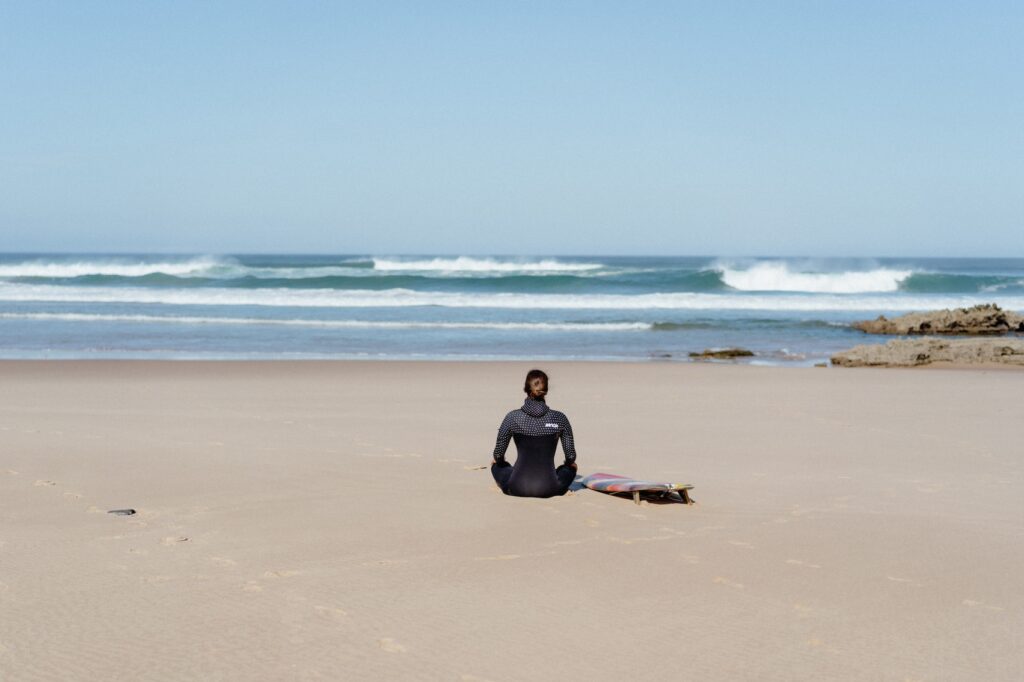
What lives underneath fear
If part of your fear stems from worrying what others think about you, there’s another feeling that plays a huge role in your fear–avoidance cycle:
Shame.
Shame about not knowing. Shame about learning in public. Shame about being seen in process.
Surfing exposes a version of ourselves that many adults have learned to hide: the unfinished, unpolished one. A version of ourselves that we decided is not fit to be seen by others.
For people whose identity is built around competence, reliability, and being the one who knows, this exposure cuts deep.
Because the mind reads it as social risk. And social risk has always mattered to human survival. Being the one who “doesn’t get it” can feel, on a body level, like being left out of the group.
In my client’s words, it felt like this: “If I mess up this take-off in front of everyone, they’ll see what I really am – someone who shouldn’t be out here.”
The fear of the wave was real, but the sting underneath was the fear of being exposed.
Shame makes the fear cycle stickier. Fear says, “This could go wrong.” Shame adds, “And if it does, it will prove there’s something wrong with you.” When those two combine, avoidance starts to feel like the only sane option.
This is why simply telling yourself to “be brave” often doesn’t work. You’re not only facing a wave. You’re facing the possibility of being seen in a way you’ve spent years trying to avoid.
Two parts, one conflict
We named two inner movements that pull in opposite directions.
One part is the one who longs. She loves growth, novelty, experience, and aliveness. She brings the body into the water. She is the part of you that lights up when you imagine gliding down the face of a wave, who books the trip, who sets the alarm early, who keeps coming back even after hard sessions.
Another part is the one who guards. She wants repetition, mastery, and certainty. She takes over once uncertainty appears. She scans the lineup, counts the risks, and holds the emergency brake.
Neither is wrong and both are protective.
For my client, the guard was not only protecting her from physical danger. She was also guarding her from shame. From the moment a situation felt chaotic or unfamiliar, the guard stepped in with one clear instruction: “Do not let them see you fail.”
That is when she would pull back from waves she could have taken, paddle to the shoulder, or leave the water early.
The difficulty begins when the guard takes over, completely shutting out the longing part. For my client, despite the fear, it feels like safety. It feels like avoiding a kind of internal humiliation: that hot, sinking sensation in the chest when you think everyone just watched you “prove” you don’t belong.
The longing part quietly suffers here. She knows why she came. She remembers the yes in her body when she saw the forecast, the way her whole being leaned toward the ocean. But every time the longing part moves forward, the guard imagines not just a wipeout, but an audience. An imagined row of judges in the lineup, taking notes.
Inside, the conversation sounds something like this:
The one who longs: “Just go for this one. You’ve done this before. It’s so much fun.”
The one who guards: “If you miss it again, everyone will notice. Better to wait. Better not to risk it.”
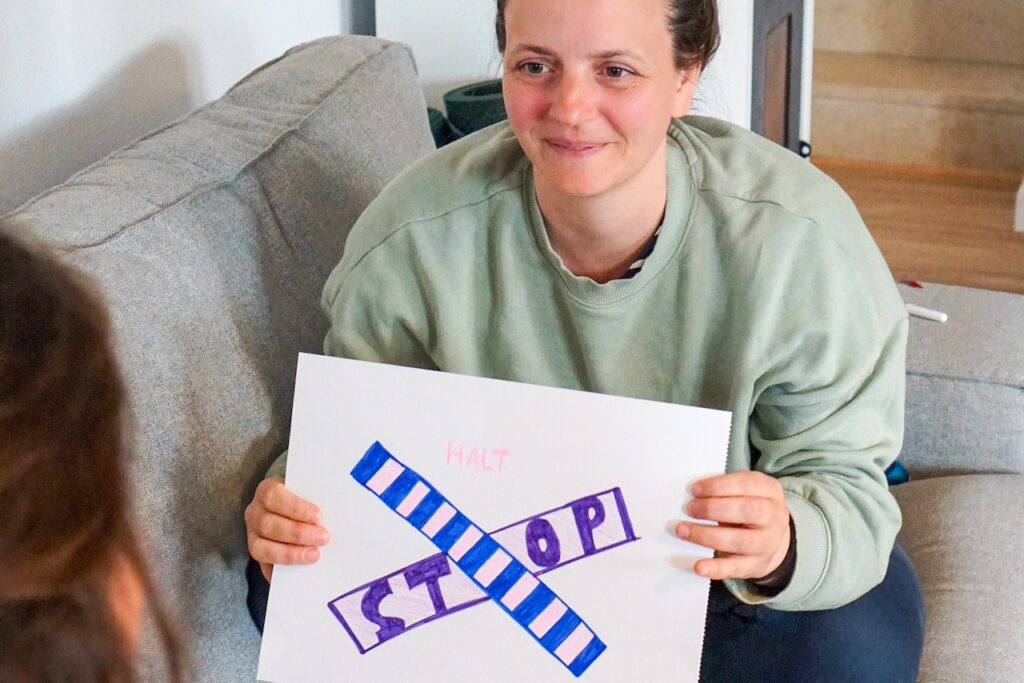
My clients guard is fiercely loyal to her safety – including her social and emotional safety. She would rather sacrifice joy than expose her to the sting of shame.
The work in our session was not to silence either part, but to let them talk to each other differently.
We practiced letting the one who longs name what she truly wants: “I want to learn. I want to feel the wave, even if I look messy. I want to have fun.”
And we let the guard name what she truly fears: “I’m scared they’ll see you as incompetent. I’m scared that if you fail, you’ll feel that horrible shame again.”
When shame is named, the guard doesn’t have to shout as loudly. She no longer has to slam on the brakes without explanation. Instead, we can thank her for her job and give her a new brief:
“Help me stay safe enough to try. Not to be perfect. Not to impress. Just safe enough to stay in the game.”
Over time, this shifts the conflict. The one who longs and the one who guards stop being enemies. They become partners, negotiating in real time: How can we protect ourselves without abandoning what we came here for?
In the lineup, that might look like:
- Choosing a slightly smaller peak while still staying in the zone where waves actually break.
- Committing to one specific kind of attempt per session (for example, “I will paddle for three waves even if people watch me miss them”).
- Letting yourself celebrate the act of trying, not just the outcome, so that being seen in process slowly becomes less shameful and more normal.
Bit by bit, the inner message shifts from “Don’t let them see you” to “I can let myself be seen learning.”
And when that happens, fear loses one of its strongest allies: the belief that any visible imperfection is proof that you don’t belong in the water.
Surfing as an identity training ground
If surfing is the place where you feel this most – the doubt, the exposure, the sudden loss of access – you share this with many others.
At some point in the session, it became clear that the work had very little to do with waves. Surfing was just the arena.
The actual training was happening elsewhere:
- staying present while being imperfect
- acting without certainty
- trusting the body before the mind feels ready
- allowing learning to be visible
- separating fear from danger
For my client, the ocean and surfing became a mirror for how tightly her identity was tied to competence and control, echoing old stories: “I must not fail. I must not look clueless. I must not take up space unless I’m good at it.”
The ocean reveals where you rely on control instead of trust, where you equate visibility with shame, where you only allow yourself to belong when you’re already good. And in doing so, it offers you a training ground to rewrite those rules, one session at a time.
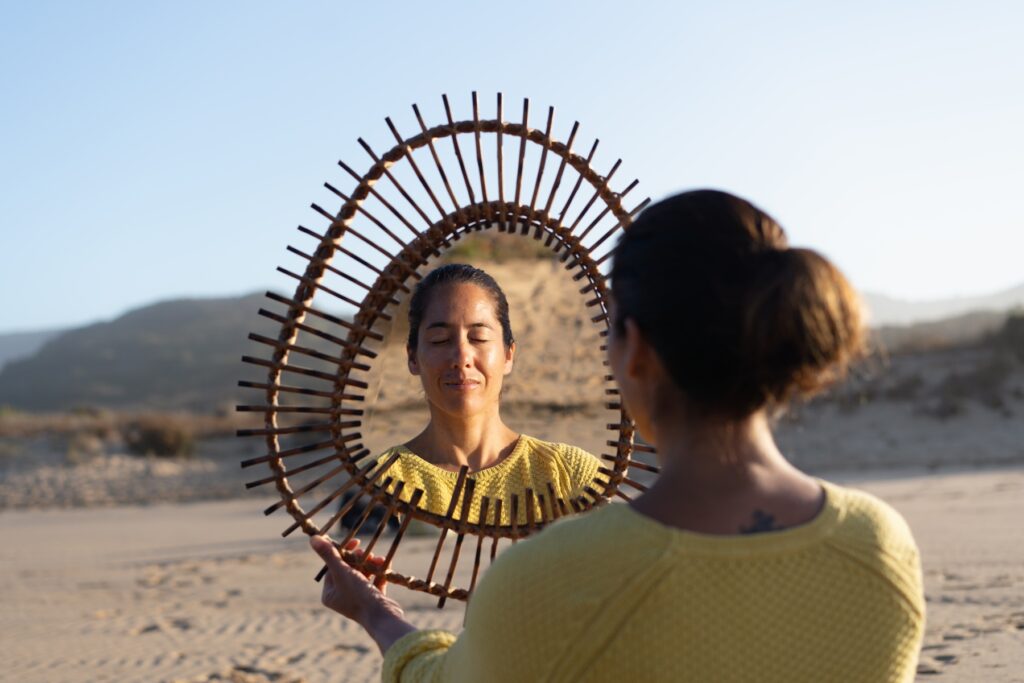
A quieter kind of confidence
Toward the end of the session, a sentence appeared and stayed.
I can manage.
It shifted the focus from control to response. From prediction to capacity.
Instead of “I must make sure nothing goes wrong”, the compass became “If something happens, I can meet it.”
This kind of confidence doesn’t demand that you feel fearless. It doesn’t require perfect conditions or perfect performance. It grows from the small, repeated proofs that you can stay with yourself, even when your heart races and your legs shake.
For someone who has always relied on being the most prepared, the most competent, the most in control, this is a radical shift. Confidence stops being about never messing up and starts being about knowing you’ll come back to yourself when you do.
When people start working from this place, fear often still appears. But it no longer decides.
Three directions for practice
(If you’re skimming, this is the part to pause on.)
We didn’t work with more techniques. We worked with order.
Body first.
Because safety is learned through sensation and repetition, not just through insight. Start by noticing: what does “too much” feel like in your body – tight chest, shallow breath, buzzing thoughts? Then practice small steps that keep you just under that threshold: for example, sitting a tiny bit deeper in the lineup than usual for 10 minutes, smiling at someone in the line-up and saying hello or asking someone to help you catch a wave. Let your body learn, through experience, “I was activated, and I stayed. Nothing terrible happened.”
Mind second.
Because distance from worry creates space for choice. Instead of trying to stop anxious thoughts, practice naming them: “My brain is predicting disaster again,” or “This is just the story that I’ll embarrass myself.” You don’t have to argue with the story. Just notice it and gently shift your attention back to something concrete – your paddling rhythm, your breath, the feel of the board under your hands or body. The goal is not to have no thoughts. It’s to remember that you are more than what your thoughts predict.
Identity last.
Because confidence grows through lived evidence, not just reassurance. This is where shame slowly loosens. Each time you let yourself be seen learning – missing a wave, standing up late, getting caught inside – and you still stay, you are sending a different message to your system: “I am allowed to exist here even when I’m not perfect.” Over time, your identity shifts from “I’m only okay when I perform” to “I’m someone who stays, learns, and returns.” That is the kind of identity that can hold fear without collapsing.
You don’t need to force it or push through your fear. Just be patient with yourself, taking mini-step by mini-step. Allowing the fear to be there, but doing it anyway. And in that, using the ocean as your living, moving classroom to retrain your relationship with fear.
Ready to feel more confident in the ocean and in life?
Many people who resonate with this pattern have spent years trying to fix themselves. What usually helps more is understanding the logic of the system they already have.
Nothing here is broken. If this feels familiar, every reaction you have in the water has a history, a logic, a purpose – even if that purpose is outdated now.
And with the right kind of practice, your access to your thinking, feeling and doing returns.
If you want to feel safer in the ocean and become more confident in the line-up and in your life, this is how you can work with me:
- Online 1:1 coaching in German or English (Zoom meeting): https://surfmentaltraining.com/en/
- Surfcoaching & Mental Training Retreats „The Confident Surfer“ in Portugal (we have a training week for each level „new learner / white water“, „experienced beginner / green waves“ and intermediate „shortboard, already doing basic turns“: https://surfmentaltraining.com/en/surftrainingretreats/
- Online Workshop „From Fear to Flow“: https://surfmentaltraining.com/from-fear-to-flow-online-workshop/
And if you prefer a gentler start, join my newsletter. I share regular tools and reflections to help you build emotional clarity and ocean confidence, step by step.
Sign up HERE 🙂

Recent Comments